
A six-person team from the San Luis Valley area Juniors 4-H program competed in a Livestock Judging event and came home with (multiple) ribbons.
This item is available in full to subscribers.
To continue reading, you will need to either log in to your subscriber account, below, or purchase a new subscription.
Please log in to continue |
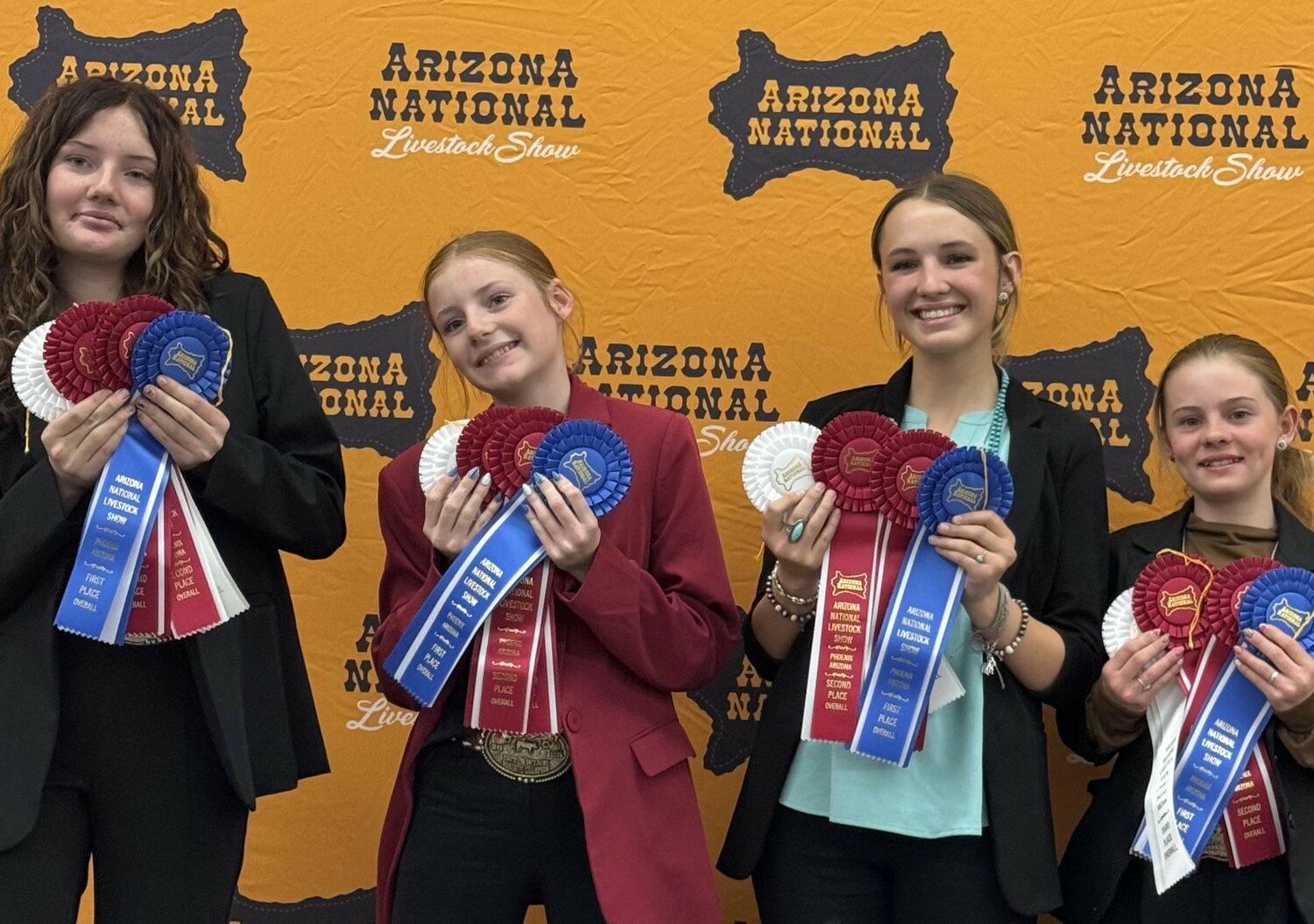
ALAMOSA — Over the holidays, a six-person team from the San Luis Valley area 4-H program headed south to Arizona where they competed in a Livestock Judging event. Make no mistake - this was a pretty big deal. The competition wasn’t held at some small, out of the way venue but was part of the annual Arizona National Livestock Show held at the Arizona state fairgrounds. According to SLV 4-H Saguache County Program Coordinator Barbra Macias, it is known for being the largest show in the southwest.
Competing against an impressive field of twenty teams involving 86 contestants who came from all over the country, the SLV 4-H team of six did very well, scoring First Place team swine, the Second Place team cattle, Second Place team oral reasons, a distinguished Third High Team Overall, and Sixth Place team sheep and goats.
To understand what all this means, the Valley Courier asked Macias to explain what exactly is involved in livestock judging.
“We judge livestock to differentiate between superior, average, and inferior animals within each of the livestock industries. A livestock judging contest is simply a collection of various classes of four livestock.”
She went on to explain that the Arizona National contest included 8 classes of beef cattle, sheep, goats, and swine. The contestants place the classes 1st-4th (12 minutes per class) and are scored on their placings and difficulty of the class.
The contestants then have the opportunity to give one set of oral reasons after the judging is completed. Oral reasons allow a contestant to justify their placings to an official judge, who scores them on accuracy, completeness, length, presentation and delivery, and terminology.
This contest consisted of eight classes to judge, and one set of oral reasons.
As Macias explains it, livestock judging seems to be a pretty complex and sometimes confusing sounding sport, involving a number of discreet skills demonstrated in what could be a pretty intimidating situation. With that in mind, it’s also important to note that the team members were competing as Juniors, which is only open to contestants who are eight to thirteen years old.
Wow.
First formed in 1902, 4-H continues to be an extraordinary program that not only provides students with fun and interesting experiences in a huge range of areas of interest but also does so while teaching skills that are foundational to their development and success as they age.
Livestock judging may be complex and even confusing, at times, but it is just one example of a 4-H experience that takes things one step further by creating opportunities, often at a state or national level, where kids can practice and demonstrate what they have learned, sometimes in pretty high stakes settings.
So, what skills does livestock judging teach? Critical thinking, communication, organization, decision-making and independence.
There is no shortage of adults who could use a little brushing up on some of those skills. Maybe we should just ask one of the students who participate in 4-H to show us how it’s done.


