
ALAMOSA COUNTY — Sangre de Cristo School District recently announced that it has been accredited by the Colorado Department of Education as a “District with Distinction”, granted to districts that are the highest performing and meet or exceed standards on the majority of performance tasks.
This item is available in full to subscribers.
To continue reading, you will need to either log in to your subscriber account, below, or purchase a new subscription.
Please log in to continue |
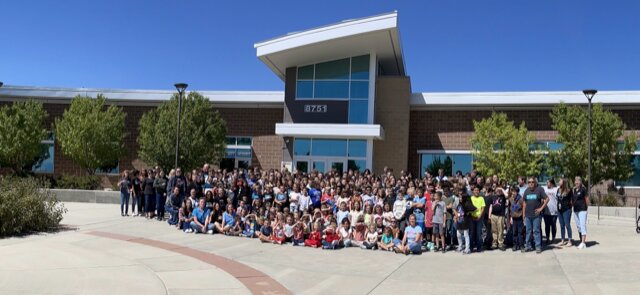
ALAMOSA COUNTY — Sangre de Cristo School District recently announced that it has been accredited by the Colorado Department of Education as a “District with Distinction”, granted to districts that are the highest performing and meet or exceed standards on the majority of performance tasks.
The school is located in the vicinity of Mosca in Alamosa County.
“There are different levels of accreditation,” explains Superintendent David Crews. “Out of 179 public school districts in the state of Colorado, only 20 are accredited at this level.”
As he explains it, three basic criteria are considered in granting the accreditation, including scores on Colorado Measures of Academic Success (CMAS), students’ scores on the Scholastic Achievement Test (SAT) and post-secondary readiness – referring to the goal that all high school graduates have the knowledge and skills to succeed in post-secondary settings and career pathways.
The district is relatively small with about 245 students enrolled in pre-K to high school grade classes. Between 40 percent and 50 percent of students are on free or reduced lunch.
But one of the things that makes Sangre de Cristo School District special is its surroundings. “We’re in a small, tightly knit community that’s fiscally sound, and they’re very supportive of the school,” says Crews. “They perceive us as being focused on academics and pursuing excellence.”
Jenna Mondragon, principal of Sangre de Cristo High School, echoes Crews, reiterating that each of the schools is very focused on academics and much of their planning is data driven with teachers looking at results of tests as points of reference. “Every student is looked at and assessed at each level of school.”
That data is then used to diagnose what a child needs in order to progress. In recognition that that kind of individual attention is difficult in class sizes that can range from 18 to 20 students, each elementary classroom is staffed with two additional professionals besides the teacher - an interventionist and a coach.
Mondragon, who taught elementary school for seven years, says that approach – especially in elementary classes - results in almost individualized instruction when kids really need that attention the most.
“And the students really are excelling,” she says.
When asked to cite an example of how their approach plays out in the classroom, Mondragon says, “We’ve had cases when kids have come here in the second grade, and they don’t know how to read. They may not even know their letters.”
When a student is falling behind at that young age, it’s especially concerning since, it’s during those early years, building blocks for future educational achievement are formed.
“So, that second-grader works with an interventionist and a coach and is also is provided with [the learning aid] Text-to-Speech technology that helps them learn to read. By the time they enter middle school, they don’t need that anymore.”
Sangre de Cristo School District also offers strong extracurricular activities that engage kids in school. Out of the 31 students who participate in Future Business Leaders of America (FBLA), 27 went to state, Mondragon says. Their knowledge bowl team went to state plus six students in Future Farmers of America went to the state convention while 18 advanced to the next highest level. The National Honor Society has “a good turnout” when they meet, and they also have “a decent sports program that the community really supports.”
Secondary teachers are also getting qualified to teach concurrent classes – that is, classes where students earn both high school and college credit. And parents are involved in the school.
But when asked what, overall, they think plays the biggest role in the district achieving such high accreditation, both Crews and Mondragon credit the staff.
“We have some very devoted staff,” Mondragon says. “They’re very committed, they put in a lot of extra hours and connect with the kids really well. And they tend to stay with the district, too.”
“We look at our positions as support for the staff,” Crews says. “That’s what our job is about. But the district still has challenges. We need to pay our teachers more, and we’re hoping for a mill levy in the future. We can also improve our vocational tracks for students who don’t want to attend college. So, there are still challenges.”
Mondragon agrees, adding, “But we’re succeeding because we’re a team. It’s a team effort. If our staff didn’t come together like they do, we wouldn’t achieve what we’re achieving with our students. And I couldn’t be more proud.”


