
ALAMOSA — The Salazar Center at Adams State University hosted its annual Rio Grande State of the Basin Symposium over the weekend, which included a panel discussion around forest resiliency with a focus on wildfires.
This item is available in full to subscribers.
To continue reading, you will need to either log in to your subscriber account, below, or purchase a new subscription.
Please log in to continue |


ALAMOSA — The Salazar Center at Adams State University hosted its annual Rio Grande State of the Basin Symposium over the weekend, which included a panel discussion around forest resiliency with a focus on wildfires.
When asked how wildfires have changed over the years, Dan Dallas, United States Forest Service and former forest supervisor of the Rio Grande National Forest, spoke about his experience in fire suppression.
“When I started my career, I might be away from home for 30 days. That was huge. But within the last five years, the peak was 84 days and the average 74 to 76. That gives you a sense of how things have accelerated,” he said.
Also, models based on 50 years of data that have predicted how fires will behave no longer apply. “We used to depend on fires never going over the top of tall mountains, like along the Continental Divide and in the Sangres. That doesn’t work anymore. That’s what the East Troublesome fire was about - the fire went over the top of the mountain,” Dallas said.
The East Troublesome fire was in Grand County in 2020, ultimately burning almost 194,000 acres.
“We used to know aspen would slow down a fire. But we can’t count on that anymore. We’ve had to recalibrate because it’s getting drier and drier and drier. So, we need to expect more. Be prepared more. We need to work together on a much larger scale and do those things we know we should do.”
The thinning of trees is one of “those things”, as explained by Adam Moore, Supervisory Forester with the Colorado State Forest Service (CSFS).
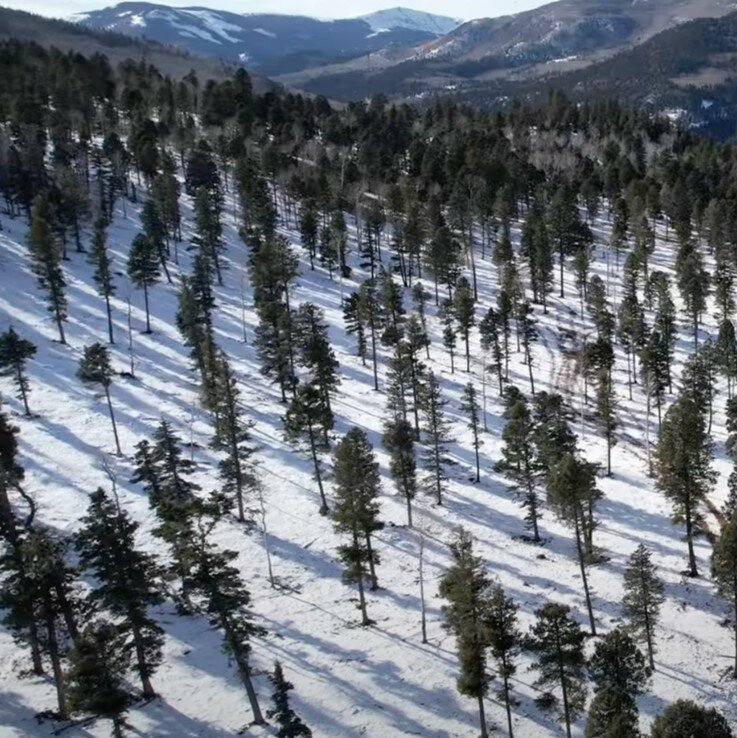
To protect a community or places of value like reservoirs and watersheds, he said, “(CSFS) likes to open the canopy up to create some separation between the trees so the fire doesn’t stay as an active crown fire.”
A crown fire is a type of wildfire that spreads rapidly through the tops of trees and shrubs fueled by dry vegetation and high winds.
“There may be some single tree torching,” he said, “but, when the canopy is opened up, the fire will drop down so that firefighters can more safely put the fire out, and it isn’t as catastrophic.”
But, again, scale matters.
“We used to do these treatments where we’d go 100 feet in from a road or a community. Then it changed to 300 feet because scientists told us it needed to be bigger to protect them. Now, with the large fires we’re seeing such as the West Fork Complex in 2013, we’re talking 600 feet, a quarter or half mile distance to create buffers protect communities or reservoirs and other. Oftentimes, that land’s not under single ownership.
“We’re also doing these treatments out further in the watersheds,” Moore said. “They may seem random but the impact they have on the watershed creates an area where the burning won’t be as severe. We wouldn’t have gotten that same effect with just doing 300 acres like we did a few years ago.”
Lindsay Quam, Deputy Director and Tribal Liaison, New Mexico Forestry Division, emphasized the importance of education while echoing the crucial need to increase both the scale and pace in treating forest lands.
“We need to educate - not just the public but the policy makers. The lawmakers. If we can’t change that, our hands are tied. People who don’t understand what we do are making decisions and, without us informing them, we get bad policy.”
Quam also stressed educating those living in the wildland urban interface. “People are moving into the forests, and what I hear is, ‘You want us to cut down trees? That’s why I moved here.’ Then, ‘Oh, you’re not going to fight fire because it’s dangerous for you? My insurance is getting dropped. What are you going to do to help me with my insurance?’ Those are the types of things we’re dealing with and will continue to deal with, but I’m hoping we can collectively fix it.”
Forests are often not recovering after an intense wildfire has occurred. “We’re not seeing a lot of trees because fires are taking out a lot of parent trees,” Quam said. “It’s changing the structure of the forest and soil, which isn’t conducive for plant or seedling growth. It’s bare rock.
“Where we used to see Ponderosa and maybe mixed Conifer up into the Spruce, it’s now becoming shrub, and that’s probably all it’s going to be. It’s scary because it’s getting hotter and drier. If we have [vegetation] type conversion in the next hundred years, whatever we have down in the Juniper and Piñon may move up to the Ponderosa which may move up to the mixed Conifers and on and on so that, eventually, we’re going to lose forests. We’re also starting to see insect problems and virus in higher elevation forest that we haven’t seen in at least 500 years. This is changing those forests and impacting our water because where are our watersheds? They’re up in those higher forests.”
Daniel Denipah, Director of Forestry, Santa Clara Pueblo and highly regarded for his method of restoration, spoke of what the loss of the forest, the shrubs, bushes and other plants signified to his tribe. “Big fires are consuming a lot of culturally significant plants and animals that are important to Santa Clara Pueblo and other reservations and tribes. It’s part of our identity and who we are. We’re hearing that we have to change our way of thinking and use different plants and things and we don’t want to hear that because that’s who we are. So, we’re looking at whole systems, people up and down the mountain range, and applying good fire projects that include reservation land and land that borders the reservation.”
Dallas picked up on Denipah’s point. “I would offer everybody in this room to change how we think, especially with the good fire -bad fire paradox. We’ve all been brought up to think that all fire is bad, but there’s good fire. There are ecosystems that depend on fire for their existence but, because we’ve done a whole bunch of things – growth in the interface, insurance industry – now we’re having very large fires that haven’t happened in our history. What we’re doing is changing whole systems. Not all fire is bad. There is good fire, and we need it”.


